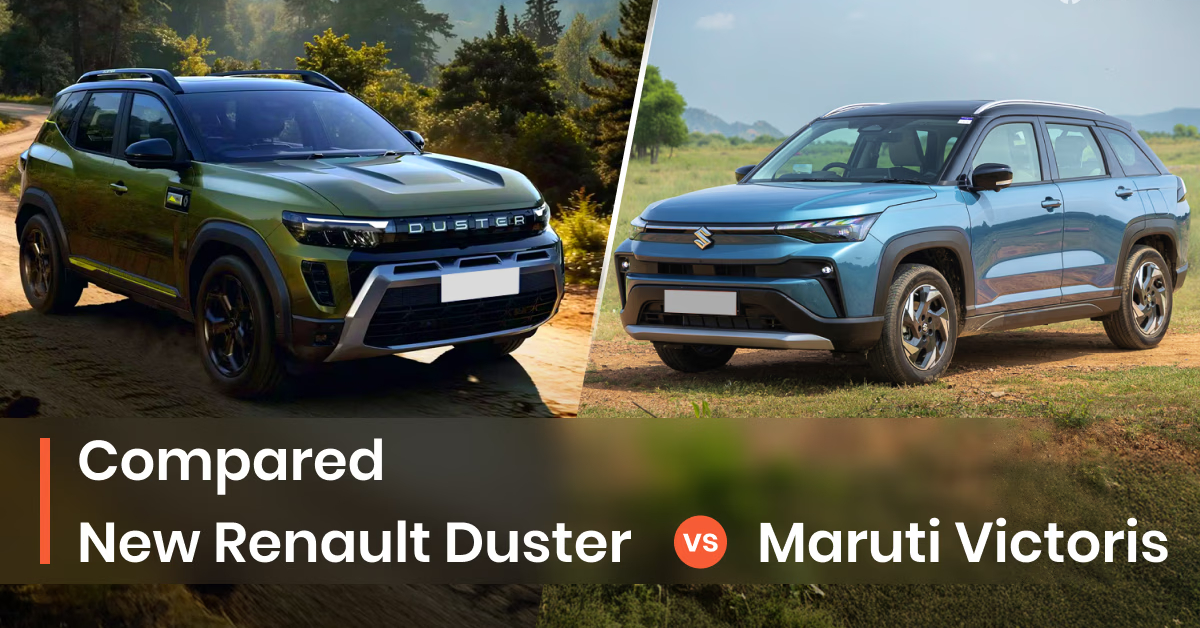
The Indian SUV market is heating up once again, and two highly anticipated models are already creating massive buzz even before their official launch — the 2026 Renault Duster and the Maruti Suzuki Victoris. Both SUVs are expected to redefine the mid-size SUV segment with modern design, advanced features, improved fuel efficiency, and competitive pricing.
While Renault is betting big on the return of its iconic Duster badge, Maruti Suzuki is preparing to strengthen its premium SUV portfolio with the all-new Victoris. On paper, both SUVs look promising, but which one truly stands out in terms of design, performance, features, and overall value? Let’s take a detailed look.
Design & Road Presence: Rugged vs Premium Appeal
2026 Renault Duster
The new-generation Renault Duster is expected to adopt a bold and muscular design language inspired by global Dacia models. It will likely feature a wider grille, LED headlamps, squared-off wheel arches, and a strong SUV stance. Renault seems to be focusing on a rugged, adventure-ready image, appealing to buyers who want a tough-looking SUV with off-road credibility.
High ground clearance, roof rails, chunky cladding, and larger alloy wheels are expected to enhance its road presence. On paper, the Duster looks more like a traditional SUV rather than a city-focused crossover.
Maruti Suzuki Victoris
The Victoris, on the other hand, is expected to take a more premium and urban approach. Maruti Suzuki is likely to position it above the Brezza, offering a sleek design with modern LED lighting, a sculpted bonnet, and clean body lines.
Instead of rugged styling, the Victoris may focus on sophistication and elegance, making it attractive for urban buyers and family users. Its design philosophy seems to be more about refinement than aggression.
Design Verdict:
If you prefer a bold, off-road-inspired SUV, the Duster looks more exciting. If premium styling matters more, Victoris could win hearts.
Engine Options & Performance Expectations
Renault Duster 2026
Renault is expected to offer multiple powertrain options, including turbo-petrol and possibly a mild-hybrid setup. There is also speculation about an AWD (All-Wheel Drive) variant, which could give the Duster a massive advantage over rivals.
Expected highlights include:
- Turbo petrol engine
- Manual and automatic transmission options
- Strong torque output
- Better highway stability
The Duster has always been known for its solid ride quality and handling, and the 2026 model is expected to improve further.
Maruti Suzuki Victoris
Maruti Suzuki will likely focus on fuel efficiency and reliability. The Victoris may come with a refined petrol engine paired with mild-hybrid technology, keeping running costs low.
Expected highlights include:
- Petrol engine with hybrid tech
- Smooth automatic gearbox
- Excellent mileage figures
- City-friendly performance
While Victoris may not offer AWD, it will likely excel in daily usability and long-term ownership costs.
Performance Verdict:
Duster looks stronger on power and capability, while Victoris may be more efficient and refined.
Mileage & Fuel Efficiency
Fuel efficiency remains a major deciding factor for Indian buyers.
- Renault Duster 2026: Expected mileage could be around 15–18 km/l depending on the engine.
- Maruti Suzuki Victoris: Likely to offer better fuel efficiency, possibly around 18–22 km/l due to hybrid assistance.
Mileage Verdict:
Victoris clearly takes the lead when it comes to fuel economy and low running costs.
Interior Quality & Cabin Features
Renault Duster
The new Duster is expected to receive a major interior upgrade, including:
- Large touchscreen infotainment system
- Digital instrument cluster
- Wireless Android Auto & Apple CarPlay
- Premium upholstery
- Improved cabin insulation
Renault is likely to focus on durability with a functional yet modern interior layout.
Maruti Suzuki Victoris
Maruti Suzuki is known for offering feature-rich cabins, and Victoris is expected to include:
- Panoramic touchscreen display
- Soft-touch dashboard materials
- Premium sound system
- Wireless charging
- Rear AC vents
- Spacious rear seating
Victoris may feel more luxurious and family-friendly inside.
Interior Verdict:
Victoris wins on premium feel, while Duster focuses on practicality.
Safety Features Comparison
Safety is becoming a priority in the Indian car market.
Expected Safety Features in Both SUVs:
- 6 airbags
- ABS with EBD
- Electronic Stability Control
- Hill hold assist
- Rear parking camera
Renault may offer a stronger body structure, while Maruti could focus on smart driver assistance features.
Safety Verdict:
Both SUVs are expected to be well-equipped, but Duster’s solid build may give it a slight edge.
Expected Price & Value for Money
Pricing will be a key factor in determining success.
- 2026 Renault Duster: Expected price range ₹11 lakh – ₹16 lakh
- Maruti Suzuki Victoris: Expected price range ₹10.5 lakh – ₹15 lakh
Maruti Suzuki’s wide service network and resale value will attract budget-conscious buyers, while Renault will target enthusiasts looking for something different.
Ownership Experience & Brand Trust
Maruti Suzuki enjoys unmatched trust, low maintenance costs, and strong resale value. Renault, however, is aiming to rebuild its brand image with better products and improved after-sales service.
Final Verdict: Which SUV Looks Better on Paper?
Choose the 2026 Renault Duster if you want:
- Bold SUV styling
- Strong performance
- Possible AWD capability
- Better highway and off-road confidence
Choose the Maruti Suzuki Victoris if you want:
- Premium design
- Better mileage
- Feature-rich interior
- Lower ownership cost
On paper, the Renault Duster looks more exciting for enthusiasts, while the Maruti Suzuki Victoris appears to be the smarter, safer bet for everyday buyers.