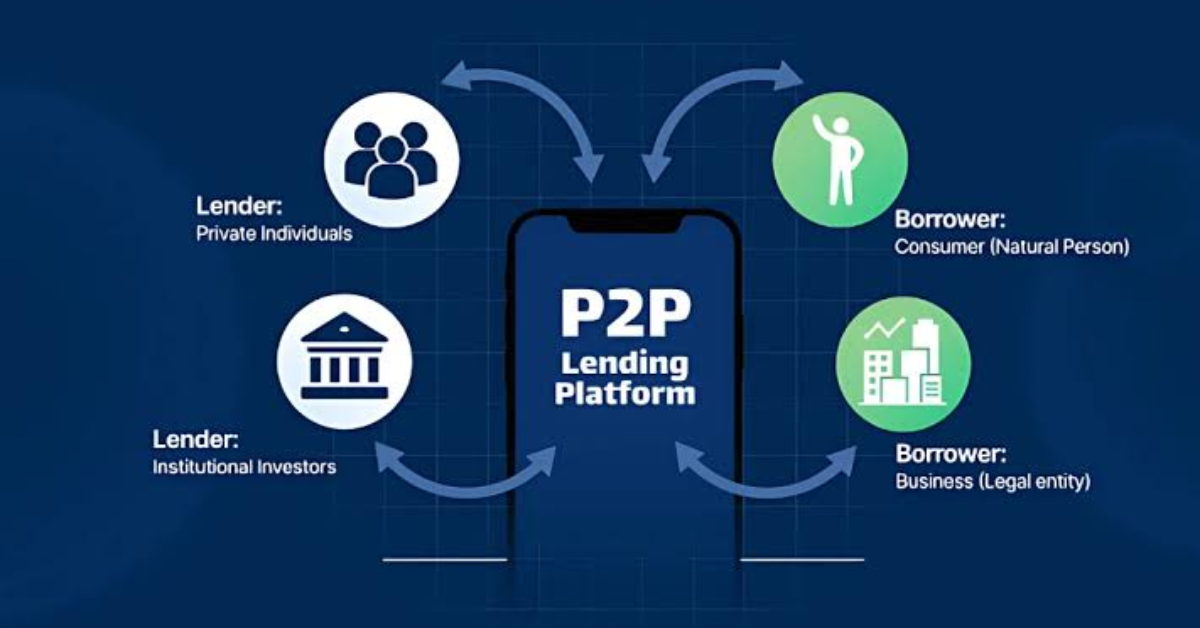
P2P lending is a system where individuals borrow money directly from other individuals or investors through an online platform, instead of taking a loan from a traditional bank. In simple words, a digital platform acts as a bridge between people who want to borrow money and people who want to invest money for returns. Because of this direct connection, P2P lending is often seen as an alternative way to access credit, especially for borrowers looking for quick funding options or investors seeking potentially higher returns.
At first glance, P2P lending may seem similar to a normal personal loan because the borrower receives money and repays it in installments with interest. But the structure behind it is very different. In a bank loan, the bank lends its own money. In P2P lending, the platform itself generally does not lend the money. Instead, it connects borrowers with individual lenders or investors who are willing to fund the loan.
This model has gained attention because it offers flexibility, convenience, and an entirely digital borrowing experience. However, like any financial product, P2P loans also come with risks, responsibilities, and terms that borrowers and investors must understand clearly before getting involved.
If you have ever wondered how peer-to-peer loans work and whether P2P lending is the right option for borrowing or investing, here is a detailed guide to help you understand the full picture.
What Is Peer-to-Peer Lending?
Peer-to-peer lending is an online lending model where borrowers and lenders connect through a digital platform. The platform matches people who need funds with people who are willing to lend money in exchange for interest income.
In this arrangement, there are usually three main participants:
- Borrower – the person who wants a loan
- Lender or Investor – the person who wants to invest money and earn returns
- P2P Platform – the online marketplace that connects both sides, manages onboarding, verifies users, and helps facilitate repayments and transactions
The platform may perform borrower verification, credit assessment, risk profiling, and documentation. But unlike a bank, it typically does not use its own balance sheet to lend the money. The actual funds usually come from individual lenders or multiple investors participating in the loan.
How P2P Lending Works Step by Step
To understand P2P lending properly, it helps to break the process into simple stages.
1. Borrower Registers on the Platform
The first step is that a borrower signs up on a P2P lending platform and fills out an application. The borrower provides personal, employment, income, and identity details, along with the required documents.
The platform may ask for information such as:
- Name, age, and contact details
- Identity proof and address proof
- PAN or tax documents
- Salary slips, bank statements, or income proof
- Employment or business details
- Existing loan obligations
- Reason for borrowing
The borrower may also be asked how much money is needed and over what repayment period.
2. Platform Evaluates the Borrower’s Profile
Once the application is submitted, the platform usually reviews the borrower’s profile to understand the level of risk involved. This may include checking:
- Credit score and repayment history
- Income stability
- Existing debt burden
- Employment background
- Financial behavior and affordability
Based on this assessment, the platform may assign the borrower a risk category or internal rating. This risk grading is important because it helps lenders decide whether they want to fund the loan and at what interest rate.
Borrowers with stronger credit profiles and stable income may receive better terms, while riskier borrowers may face higher rates or lower chances of funding.
3. Loan Listing Is Shown to Potential Lenders
After evaluation, the borrower’s loan request may be listed on the platform for potential lenders or investors. Depending on the platform’s structure, lenders may see information such as:
- Loan amount requested
- Borrower risk category
- Tenure of the loan
- Interest rate or expected return range
- Purpose of the loan in broad terms
- Repayment schedule
The borrower’s personal identity is generally not displayed in a public way, but lenders get enough financial and risk-related information to make a funding decision.
4. Lenders Choose Whether to Fund the Loan
Investors or lenders on the platform can review available borrower listings and decide where they want to put their money. In many cases, a single borrower’s loan may be funded by multiple lenders rather than just one person.
For example, if a borrower wants ₹2 lakh, the platform may divide that amount into smaller portions and different lenders may contribute separate amounts. This helps spread risk for lenders and makes the funding process more flexible.
Once enough lenders commit money to the loan request, the funding is completed.
5. Loan Agreement and Disbursal Take Place
After the loan is fully funded and all platform conditions are met, the agreement is finalized and the money is disbursed to the borrower. The borrower then begins repayment according to the agreed terms.
Repayment is usually made in monthly installments, similar to EMI-based loans. The platform may collect payments from the borrower and distribute them proportionately to the lenders who funded the loan.
6. Borrower Repays the Loan With Interest
The borrower repays the loan over the selected tenure. Each installment generally includes principal and interest. The platform may handle repayment tracking, reminders, and collection support.
For the lender or investor, the return comes from the interest paid by the borrower. The exact return depends on the interest rate, borrower risk, defaults if any, and platform charges.
Key Features of P2P Loans
Peer-to-peer loans differ from traditional loans in several ways. Here are some of the main features:
1. Direct borrower-investor connection
Instead of borrowing from a bank’s own funds, the borrower is funded by individuals or investors through the platform.
2. Entire process is largely online
Registration, application, verification, agreement, and repayment tracking are usually handled digitally.
3. Unsecured nature in many cases
Many P2P loans are unsecured, meaning the borrower may not have to pledge collateral. Approval is often based on creditworthiness and platform criteria.
4. Risk-based pricing
Interest rates may vary depending on the borrower’s risk profile. A better credit profile may improve borrowing terms.
5. Multiple lenders can fund one borrower
A loan can be split across many lenders rather than being funded by a single source.
Why Borrowers Consider P2P Lending
P2P lending has become attractive to many borrowers for practical reasons. Here are some of the common advantages.
1. Access to an Alternative Source of Credit
Not every borrower gets the ideal response from traditional banks. Some people may find bank loan processes slow, restrictive, or difficult to qualify for. P2P lending provides an alternative route to seek funding.
2. Simple and Digital Process
Many borrowers like the convenience of applying online without visiting multiple branches. Digital onboarding can make the experience faster and more comfortable.
3. Flexible Use of Funds
P2P loans are often used for personal financial needs such as:
- Medical expenses
- Debt repayment
- Wedding costs
- Home repair
- Education support
- Business cash flow gaps
- Emergency household needs
4. Potentially Faster Approval
Because the process is platform-driven and digital, some borrowers may find it faster than traditional paperwork-heavy loan applications, especially when documents and eligibility are in order.
Why Investors Are Interested in P2P Lending
P2P lending is not only about borrowers. It also attracts investors who want to lend money and earn returns.
Some lenders consider P2P investing because:
- It offers an alternative investment avenue
- Potential returns may be higher than some traditional fixed-income options
- Investors can diversify by spreading money across multiple borrowers
- The digital platform makes participation easier
However, higher return potential usually comes with higher risk, especially default risk. That is why investors must be careful and diversify properly.
Risks of P2P Lending Borrowers and Investors Should Know
P2P lending can be useful, but it is not risk-free. Both borrowers and lenders need to understand the risks clearly.
Risks for Borrowers
1. Interest rates may vary widely
If your credit profile is weak, the interest rate offered may be high.
2. Missed repayments can affect credit and recovery action
If you fail to repay on time, it may hurt your financial profile and lead to collection efforts.
3. Fees and charges may apply
Borrowers should check processing fees, penalties, late charges, and platform costs before accepting the loan.
Risks for Lenders or Investors
1. Borrower default risk
The biggest risk is that the borrower may delay payment or stop repaying.
2. Returns are not guaranteed like a fixed deposit
P2P lending is not the same as guaranteed-return products. Returns depend on actual repayment performance.
3. Platform and operational risk
Investors should understand how the platform works, how collections are handled, and what happens in case of borrower defaults.
How Interest Rates Are Decided in P2P Lending
Interest rates in P2P lending are usually influenced by several factors:
- Borrower credit score
- Income stability
- Existing debt burden
- Loan amount and tenure
- Risk category assigned by the platform
- Demand and supply on the platform
- Internal platform pricing models
Borrowers with stronger financial profiles may get better rates, while high-risk borrowers may face more expensive borrowing.
Who Can Consider a P2P Loan?
A P2P loan may be worth exploring for someone who:
- Needs personal funds for a genuine purpose
- Wants an alternative to traditional lending channels
- Is comfortable with a digital loan process
- Has checked repayment affordability carefully
- Understands the terms, charges, and risks involved
At the same time, it is important not to take a loan simply because it is available online. Borrowers should still compare costs, evaluate EMI affordability, and read the full terms before accepting the offer.
Things to Check Before Taking a P2P Loan
Before applying for a peer-to-peer loan, borrowers should review the following:
- Total loan amount needed
- EMI affordability
- Interest rate and total repayment cost
- Processing charges and late fees
- Loan tenure
- Prepayment terms if any
- Credit impact of delayed repayment
- Platform reputation, transparency, and customer support process
A loan should solve a financial need, not create a larger financial problem later.
Is P2P Lending Better Than a Bank Loan?
There is no one-size-fits-all answer. P2P lending and bank loans serve different needs and may suit different borrowers.
A bank loan may be preferable for someone who qualifies for competitive interest rates and wants a traditional lender-backed product. A P2P loan may appeal to someone looking for an alternative digital borrowing option, especially if flexibility and speed matter more.
The better option depends on:
- Your credit profile
- Loan purpose
- urgency of funds
- interest rate comparison
- repayment ability
- total charges involved
That is why borrowers should compare options carefully instead of assuming one route is always better.
Conclusion
Peer-to-peer lending has created a new way for borrowers and lenders to connect without relying only on traditional banking channels. In this model, a digital platform acts as the bridge, helping borrowers seek funds from individual lenders or investors. For borrowers, P2P lending can offer flexibility, convenience, and access to an alternative source of credit. For investors, it can provide an opportunity to earn returns by funding loans directly.
To sum it up, P2P lending works like this: the borrower applies on a platform, the platform evaluates the profile, the loan request is shown to investors, multiple lenders may fund the amount, the money is disbursed, and the borrower repays it in installments with interest.
But like every financial product, P2P loans should be approached carefully. Borrowers must understand the interest rate, total cost, repayment responsibility, and consequences of default. Investors must understand that higher returns also come with higher risk.
When used responsibly, P2P lending can be a useful part of the modern credit ecosystem. The key is not just knowing that it exists, but understanding exactly how peer-to-peer loans work before making any borrowing or investing decision.