When it comes to building a secure financial future, the oldest advice is often the truest: don’t put all your eggs in one basket. While high-yield equities and mutual funds grab the headlines, Fixed Deposits (FDs) remain the bedrock of a disciplined investment portfolio. They offer safety, guaranteed returns, and complete peace of mind.
However, jumping into an investment blindly is never a wise move. To truly maximize your returns, you need a blueprint. That is where an FD calculator comes into play. It is not just a digital tool; it is a financial companion that helps you look into the future of your money.
Here is a comprehensive guide on how to leverage an FD calculator to plan your investments like a pro.
What is an FD Calculator?
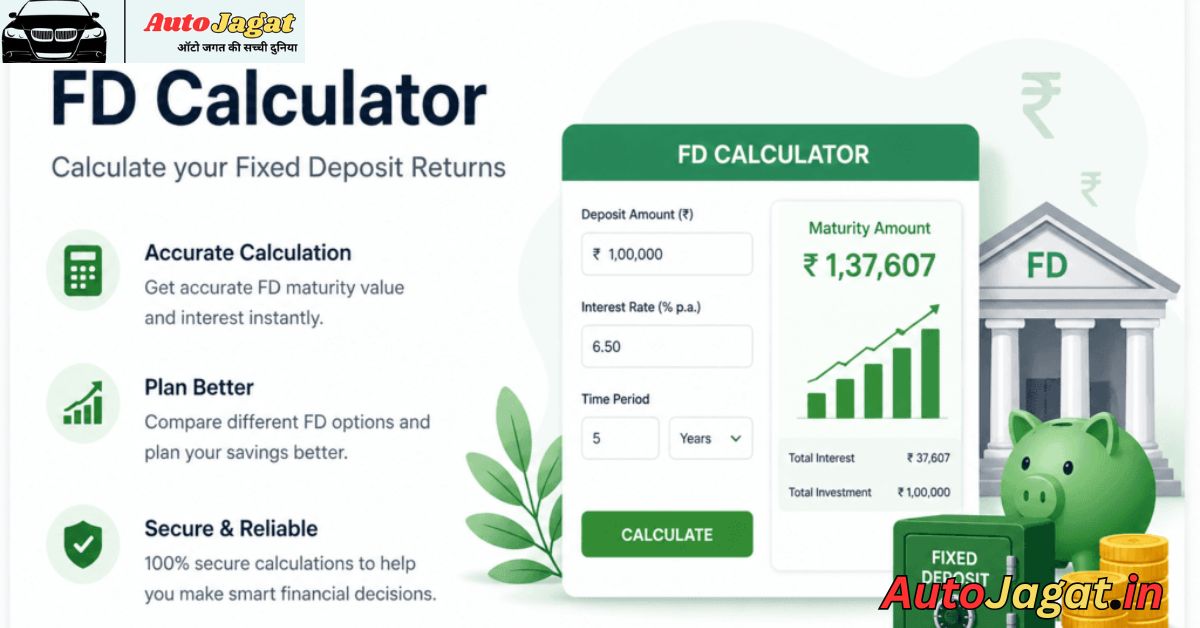
An FD calculator is a free, user-friendly online tool designed to estimate how much interest your investment will earn over a specific period. Instead of drowning in complex mathematical formulas involving compounding interest, you simply input a few key numbers, and the calculator instantly reveals your maturity amount.
To give you the exact figure, the tool relies on three basic pillars:
- Principal Amount: The initial lump sum you wish to invest.
- Interest Rate: The annual rate offered by the bank or financial institution.
- Tenure: The duration for which you lock in your money (ranging from 7 days to 10 years).
The Magic of Compounding: Simple vs. Compound Interest
To appreciate what the calculator does behind the scenes, it helps to understand how your money grows. Fixed deposits generally earn interest in two ways:
- Simple Interest: You earn interest only on the principal amount you invested.
- Compound Interest: You earn interest on your principal plus the interest accumulated from previous periods. This creates a snowball effect, accelerating your wealth creation.
Most robust FD calculators use the standard compounding formula:
A=P(1+nr)nt
Where:
- A = Maturity amount
- P = Principal amount
- r = Annual interest rate (as a decimal)
- n = Number of times interest compounds per year (e.g., quarterly, half-yearly)
- t = Total tenure in years
Manually calculating this for a 5-year tenure with quarterly compounding is a headache. An FD calculator does it in less than a second.
Strategic Ways to Plan Your Investments Using an FD Calculator
An FD calculator isn’t just for checking your future balance; it’s a strategic asset. Here is how you can use it to build a smarter financial plan:
1. Master the Art of “FD Laddering”
Locking all your savings into a single, long-term FD can be risky. If interest rates rise next year, you miss out. If you face an emergency, breaking the FD triggers a penalty.
The Solution: Use the calculator to plan an FD ladder. Split a large sum (say, $15,000) into three separate FDs of $5,000 with tenures of 1 year, 2 years, and 3 years. As the 1-year FD matures, use the calculator to see the yield of reinvesting it for another 3 years. This ensures liquidity and allows you to capture higher interest rates over time.
2. Align Investments with Financial Goals
Whether you are saving for a down payment on a car, an international vacation, or a wedding, timing is everything. Input your target savings goal into the calculator and play with the principal and tenure sliders. It will show you exactly how much money you need to park today to hit your target by your deadline.
3. Compare Different Financial Institutions
Not all banks are created equal. Smaller private banks and Non-Banking Financial Companies (NBFCs) often offer significantly higher interest rates than traditional, legacy banks. By plugging different rates into the calculator, you can visually compare the stark difference in your final payout, helping you decide if switching banks is worth it.
4. Factor in Tax Implications (TDS)
The interest earned on Fixed Deposits is taxable. If your interest income crosses a specific threshold, banks deduct Tax Deducted at Source (TDS). By using an FD calculator to see your exact annual interest breakdown, you can predict your tax liability and decide if you should opt for tax-saving FDs or split investments across family members to legally minimize taxes.
Final Thoughts: Take Control of Your Money
Financial freedom doesn’t happen by accident; it happens by design. While market-linked investments have their place for aggressive growth, Fixed Deposits provide the stability every portfolio needs to survive economic downturns.
By integrating an FD calculator into your quarterly or annual financial check-ins, you eliminate guesswork. You gain total clarity on your liquidity, your growth, and your timelines. Stop guessing what your savings will look like tomorrow. Grab your numbers, plug them into an FD calculator, and start structuring your wealth with absolute confidence today.

Hello, my name is Himanshu Kumar and I am an experienced Digital Marketer. I have been blogging for the last 4 years and I have special interest in SEO. Here I give you easy bikes and writes easy-to-understand reviews and news about the latest bikes, helping readers choose the best options.. My aim is to always provide you with accurate, new and useful information.