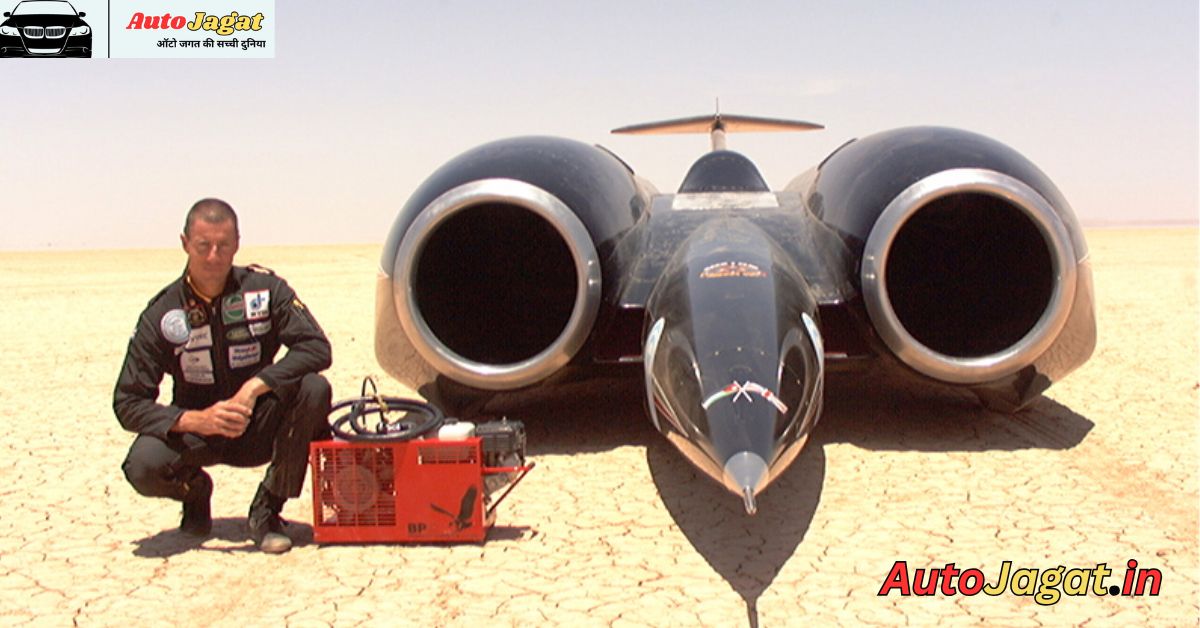
When people think of speed, they often imagine Formula 1 cars or fighter jets. But in 1997, a British-built machine called the ThrustSSC (SuperSonic Car) redefined what speed meant on land. Designed by Richard Noble and his team, and piloted by RAF Wing Commander Andy Green, the ThrustSSC became the first car in history to break the sound barrier, cementing its place in motorsport and engineering history.
🚗 Engineering Marvel
The ThrustSSC wasn’t a car in the conventional sense—it was essentially a land-based jet fighter without wings.
- Engines: Two Rolls-Royce Spey 202 turbofan engines, the same used in fighter aircraft, producing a combined 222 kN (50,000 lb) of thrust.
- Dimensions: 16.5 meters long, 3.7 meters wide, weighing 10.6 tonnes.
- Design team: Richard Noble (project leader), Glynne Bowsher (design), Ron Ayers (aerodynamics), and Jeremy Bliss (engineering).
The car’s sleek, missile-like body was built to withstand the immense stresses of supersonic travel while maintaining stability on the desert floor.
⚡ The Record-Breaking Run
On October 15, 1997, Andy Green drove ThrustSSC across Nevada’s Black Rock Desert. The car achieved a two-way average speed of 1,227.985 km/h (763.035 mph), officially breaking the sound barrier at Mach 1.02.
- Pilot: Andy Green, a decorated RAF fighter pilot, was chosen for his precision and ability to handle extreme conditions.
- Conditions: The desert’s flat surface provided the ideal environment for such a run.
- Shockwaves: Photographs from the run show visible Schlieren shockwaves emanating from the car, proof of its supersonic speed.
This achievement made Green the only person to break the sound barrier on land.
🏎️ Legacy and Impact
The ThrustSSC’s success was more than just a record—it was a technological milestone.
- Predecessor: Thrust2, which set a record of 633 mph in 1983.
- Successor: Bloodhound LSR, a project aiming to surpass 1,000 mph, though it has faced funding challenges.
- Cultural impact: The car is now displayed at the Coventry Transport Museum, inspiring future generations of engineers.
⚖️ Comparison: ThrustSSC vs. Other Record Cars
| Car | Year | Speed Achieved | Notable Feature |
|---|---|---|---|
| Thrust2 | 1983 | 633 mph | Jet-powered, record holder before SSC |
| ThrustSSC | 1997 | 763 mph (Mach 1.02) | First car to break sound barrier |
| Bloodhound LSR | Ongoing | Target 1,000+ mph | Advanced hybrid jet/rocket propulsion |
🌍 Why It Matters
Breaking the sound barrier on land was once thought impossible due to stability and safety concerns. ThrustSSC proved it could be done, showcasing the limits of human engineering and courage.
- Engineering lessons: Aerodynamics, materials science, and propulsion systems were pushed to new extremes.
- Human achievement: Andy Green’s precision driving remains legendary.
- Inspiration: The project continues to inspire innovations in aerospace and automotive engineering.
✨ Final Thoughts
The ThrustSSC wasn’t just a car—it was a supersonic experiment on wheels. By breaking the sound barrier, it redefined what was possible on land and set a benchmark that still stands today. More than two decades later, its record remains unbeaten, a testament to the vision of Richard Noble’s team and the skill of Andy Green.
The ThrustSSC reminds us that speed is not just about numbers—it’s about pushing boundaries, defying expectations, and daring to go where no one has gone before.

Hello, my name is Himanshu Kumar and I am an experienced Digital Marketer. I have been blogging for the last 4 years and I have special interest in SEO. Here I give you easy bikes and writes easy-to-understand reviews and news about the latest bikes, helping readers choose the best options.. My aim is to always provide you with accurate, new and useful information.