If you had told a driver in 1997 that by 2026 we would be stepping into cars without steering wheels, pedals, or even a charging port, they might have pointed you toward the nearest sci-fi convention. Yet, here we are in April 2026, and the Tesla Cybercab has officially transitioned from a “We, Robot” fever dream to a production reality at Giga Texas.
The Cybercab isn’t just another EV; it is Tesla’s attempt to fundamentally decouple the act of “traveling” from the act of “driving.” It is a bold, gold-tinted bet on a future where your car is a private lounge that moves.
A Design That Breaks Every Rule
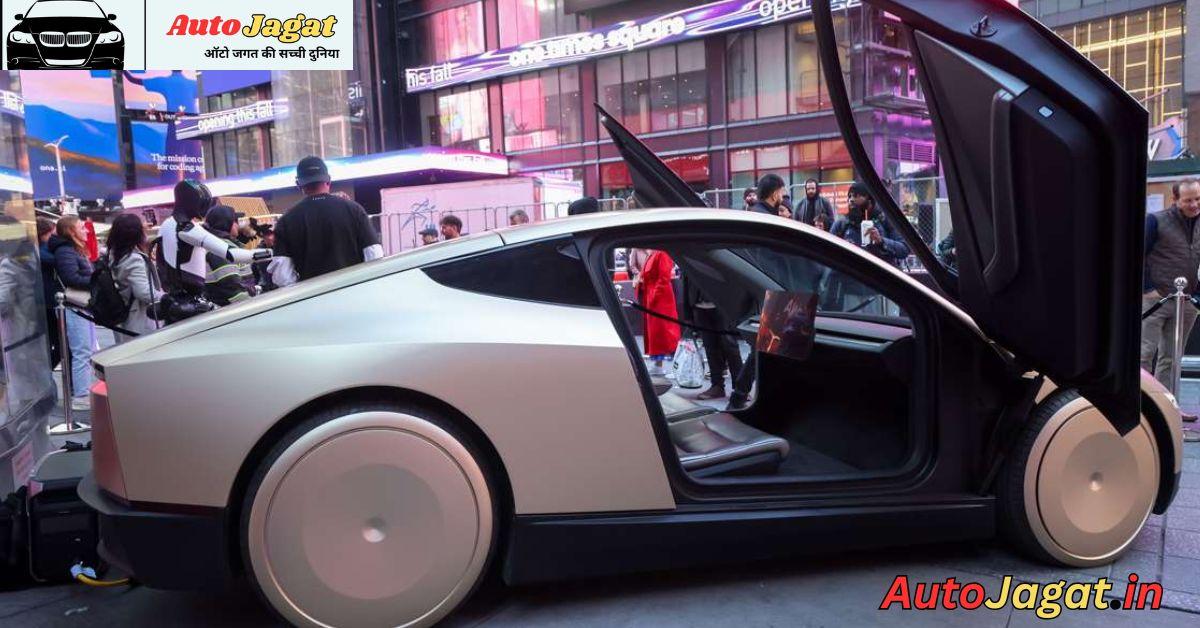
At first glance, the Cybercab looks like a Cybertruck that went to finishing school. It carries the same futuristic, angular DNA but softens the edges into a sleek, aerodynamic coupe.
The most striking exterior features include:
- Butterfly Doors: These power-operated doors swing up and forward, making ingress and egress effortless even in tight urban parking spots.
- The “Windowless” Rear: There is no rear window. Since the car is designed to be fully autonomous, the “driver” doesn’t need to look back—the car’s nine-camera suite handles the 360-degree vision.
- Disc Wheel Covers: Massively oversized, aerodynamic covers hide the staggered wheel setup, contributing to an incredibly low drag coefficient.
But the real shock comes when the doors swing open. There is nothing where the controls should be. No yoke, no pedals, no stalks. Just two comfortable seats, an expansive amount of legroom, and a massive 21-inch central touchscreen that dominates the cabin.
The Tech: Inductive Charging and “Unsupervised” FSD
Tesla has finally ditched the plug. The Cybercab is the first mass-production vehicle to rely entirely on Inductive Charging. You simply park over a pad, and the power transfers wirelessly with a planned efficiency of over 90%. It’s a “set it and forget it” philosophy that fits the robotaxi mission perfectly.
Underneath, the specs are optimized for urban efficiency rather than Ludicrous speed:
- Battery: A compact 35 kWh pack.
- Range: Approximately 200 miles (320 km).
- Efficiency: An industry-leading 5.5 miles per kWh, making it one of the cheapest vehicles to operate in history.
The brain of the operation is the latest iteration of Full Self-Driving (FSD). Unlike previous Teslas that required “supervised” attention, the Cybercab is built for “unsupervised” autonomy. Elon Musk’s vision is a world where these cars operate at a cost of roughly $0.20 per mile, making personal point-to-point transport cheaper than a bus ticket.
The $30,000 Question
Perhaps the most disruptive aspect of the Cybercab is its price tag. Tesla is aiming for a starting price under $30,000.
For the individual owner, it represents a private sanctuary for the daily commute. For the entrepreneur, it’s a turn-key business. Tesla’s “Robotaxi” network allows owners to add their cars to a fleet when they aren’t using them, potentially turning a depreciating asset into a revenue generator. It’s the “Airbnb of cars,” and the Cybercab is the dedicated guest suite.
Challenges on the Horizon
While the first production units are rolling off the line this month (April 2026), the road ahead isn’t without potholes.
- Regulatory Approval: While Texas and California have led the way in allowing unsupervised FSD, other states and countries are still grappling with the legalities of a car that has no manual override.
- The “Two-Seat” Limit: By opting for a 2-seater layout (based on data showing 91% of ride-hailing trips carry two or fewer people), Tesla has made a highly efficient tool, but it won’t be the primary family car for everyone.
- Infrastructure: Inductive charging pads need to be rolled out globally for the “no-plug” dream to work seamlessly.
Final Verdict
The Tesla Cybercab is a polarizing masterpiece. It is an unapologetic rejection of 100 years of automotive tradition. For the purists, the lack of a steering wheel is a tragedy. For the rest of us, the promise of reclaiming the hour spent in traffic—to sleep, work, or watch a movie—is a gift.
As Giga Texas ramps up to a target of 2 million units per year, the Cybercab is no longer a concept of the future. It is the new neighbor on your street.

Hello, my name is Himanshu Kumar and I am an experienced Digital Marketer. I have been blogging for the last 4 years and I have special interest in SEO. Here I give you easy bikes and writes easy-to-understand reviews and news about the latest bikes, helping readers choose the best options.. My aim is to always provide you with accurate, new and useful information.